

Precision Metal Castings from Prototype to Production
Custom Online Sand Casting Services
We deliver precision sand casting solutions for industries ranging from automotive and heavy machinery to aerospace and energy. Our foundry combines decades of expertise with modern equipment to produce complex castings in aluminum, iron, steel, and specialty alloys.
- Castings starting from 1 piece
- Reduce project costs by 15%–20%
- 3D printed molds & cores
What is sand casting?
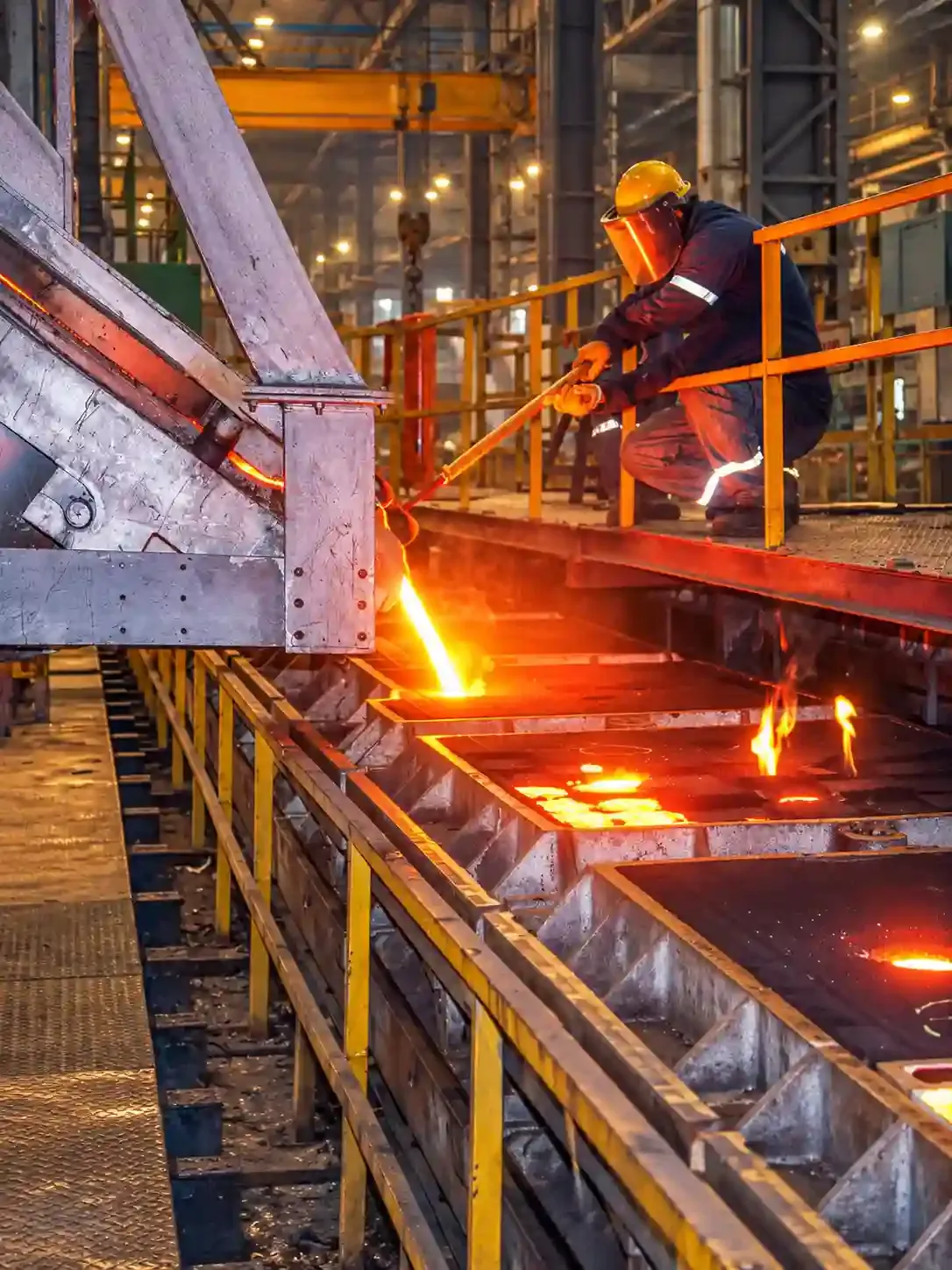
Sand casting is a metal casting process that uses a sand-based mold to form metal parts. A pattern of the desired part is used to create a cavity in the sand mold, and sand cores can be added to form internal holes or complex passages. Molten metal is then poured into the cavity, where it cools and solidifies into the required shape. Its working principle is relatively simple: the mold cavity defines the external geometry of the part, while cores create internal features. After solidification, the sand mold is broken away, the casting is removed, and the runners, gates, and excess material are trimmed. The part can then undergo cleaning, heat treatment, machining, or surface finishing as required.
What is sand casting?
Sand casting is a metal casting process that uses a sand-based mold to form metal parts. A pattern of the desired part is used to create a cavity in the sand mold, and sand cores can be added to form internal holes or complex passages. Molten metal is then poured into the cavity, where it cools and solidifies into the required shape. Its working principle is relatively simple: the mold cavity defines the external geometry of the part, while cores create internal features. After solidification, the sand mold is broken away, the casting is removed, and the runners, gates, and excess material are trimmed. The part can then undergo cleaning, heat treatment, machining, or surface finishing as required.
Key Manufacturing Capabilities
Review the key technical parameters of our sand casting process, including dimensional capabilities, surface finish, part size, and lead time.
| Project | Capability |
|---|---|
| Maximum unit weight | Up to 2,000 kg per casting |
| Maximum sand-printing dimensions | 2,500 × 1,500 × 1,000 mm |
| Sand-mold printing tolerance | ±0.35 mm |
| Reported surface roughness | Ra 12.5–45 μm |
| Minimum Wall Thickness | 5mm |
| Delivery time | 5–30 days |
| Monthly production capacity | 400-ton casting |
| Secondary operations | Casting cleanup, CNC machining and dimensional inspection |
Customized Sand Casting Solutions
TigerHubs provides customized sand casting solutions from prototype validation and low-volume production to scalable mass production, supporting complex geometries, large components, and demanding industrial applications.

Sand Casting Prototype
Validate the form and function of a metal component before committing to a production pattern. For suitable designs, 3D-printed sand molds and cores allow the first casting to be made from approved digital geometry, including parts with complex internal features.
- Production capacity: 1–100 pcs
- Lead time: 1-5 days
- Best for: Functional prototypes, feasibility validation for large components, and designs still in the revision stage.

Low Volume Sand Casting
Produce a defined batch for equipment trials, pilot builds or initial customer demand. Once the prototype requirements are settled, the focus shifts to consistent material selection, repeatable machining features and agreed inspection criteria across the batch.
- Production capacity: 101-10000 pcs
- Lead time: 5-15 days
- Best for: Pilot production, replacement components, specialized machinery, and low-demand OEM parts.

High Volume Sand Casting
Plan recurring supply around a stable drawing and forecast. TigerHubs reviews whether continued 3D-printed sand molds or a conventional pattern-based route is more suitable for the required volume, while defining the casting, secondary machining and inspection scope for each production lot.
- Production capacity: >10000 pcs
- Lead time: 15–30 days
- Best for: Approved designs with repeat demand, scheduled OEM supply, and programs moving beyond pilot builds.
Post-Casting CNC Machining
Additional CNC Machining CapabilitiesSand casting forms the main body and complex geometry of a metal part, but an as-cast surface is not always the final functional surface. When a drawing calls for accurate fits, aligned interfaces or defined surface finishes, TigerHubs plans CNC machining as a secondary operation on the casting. We review the raw casting and finished-part requirements together, so machining allowance, locating datums and inspection points are considered before production—not discovered after the casting has been made.

Mounting and Datum Faces
Machine the surfaces that locate the casting within an assembly or provide a stable reference for subsequent operations.
Bores and Bearing Seats
Finish specified bores and seating features where size, position and alignment affect the fit of shafts, bearings or adjoining components.
Holes and Threads
Drill, bore and tap drawing-defined features after casting when their final dimensions or positions cannot be left to the as-cast process.
Sealing and Mating Surfaces
Finish flanges, contact faces and other interfaces where the drawing requires a controlled fit or surface condition.
- 3/4/5-Axis CNC Machining
- Precision up to ±0.002 mm
- 300+ CNC Machines
Secondary Processing Services for 3D Sand Castings
We offer several secondary operations such as painting or heat tapping inserts. You can specify which secondary operations are needed in the "custom requirements" part of your quote request. Here are some examples of secondary operations we provide:
Explore Our Sand Casting Foundry
More InformationTigerHubs supports complex and large sand castings with 3D-printed molds, casting weights up to 2,000 kg, and monthly capacity up to 400 tons. From prototype validation to production, our foundry integrates casting, CNC machining, and dimensional inspection in one coordinated workflow.


Quality Assurance for Sand-Cast Parts
TigerHubs reviews drawings, material requirements, critical dimensions, machining allowances, and inspection criteria at the start of each project. From mold and core preparation through casting, post-casting CNC machining, and final inspection, key requirements remain controlled and traceable throughout production.
Engineering & Drawing Review
Critical dimensions, datums, internal features, machining allowances, and inspection requirements are reviewed before production to reduce downstream manufacturing risk.
In-Process Quality Control
Mold preparation, cores, casting conditions, and critical production stages are monitored according to defined process and quality requirements.
Precision Inspection
CMMs, height gauges, optical projectors, and other measuring equipment are used to verify critical dimensions, machined features, and final part requirements.
Full-Process Traceability
Production and inspection information is recorded throughout the manufacturing process, providing traceability from production through final inspection and delivery.

3D Sand Casting Material Library
Choose from a range of casting alloys for different mechanical and environmental requirements. TigerHubs engineers can recommend suitable materials based on part function, operating conditions, machining needs, and project requirements.
Gray Iron
Gray iron offers good vibration damping and machinability, making it a practical choice for rigid cast components where high ductility is not the primary requirement.
Best For
Machine bases, housings, engine blocks, pump bodies
- Pouring Temp. (°C)
- 1,340–1,480
- Tensile strength (MPa)
- ≥207
- Hardness (HB/HBW)
- 174–210
TigerHubs Sand Casting Parts


Image 1 of 6
When 3D Sand Casting Is the Right Answer?
If your part has…
Sand casting is the answer because…
Internal channels or cavities
3D-printed cores handle any geometry. CNC tools can’t reach inside.
Large dimensions (>500 mm)
Molds scale to 2+ meters. No machine bed limit.
Thick walls or solid sections
Cost independent of wall thickness. No volume penalty.
Low volume (1–50 units)
Zero tooling. One part costs the same as fifty.
Wrought-grade density required
Gravity-poured, fully dense. No layer porosity.
Frequent design iterations
Change CAD → reprint mold. No tooling to revise.
If it’s too big for CNC, too hollow for SLS, and too low-volume for tooling — it’s a sand casting part.
Our 3D Sand Printing Casting Process
At TigerHubs, we combine 3D-printed sand molds with controlled casting processes to produce complex metal components efficiently. From mold preparation to final cleaning, each step is managed to maintain dimensional accuracy, casting quality, and production consistency.

Design and DFM Review
Review parting, sand cores, wall thickness, gating, machining allowances and inspection requirements from the 3D model.

3D-Printed Sand Molds
Produce molds rapidly without conventional tooling for large, complex and low-volume components.

Metal Casting and Cleaning
Complete metal pouring, cooling, shakeout, cutting, grinding and casting cleaning.

Large-Size CNC Machining
Precision-machine datums, mounting faces, holes, threads and critical mating surfaces.

Full-Dimensional Inspection
Inspect dimensions, appearance, materials and critical features according to drawings and quality requirements.
Why Choose TigerHubs Sand Casting?
TigerHubs combines casting engineering, 3D sand printing, foundry production, post-casting CNC machining, inspection, and global delivery within one coordinated manufacturing workflow. This allows us to support complex sand-cast parts from early design validation through repeat production while reducing unnecessary handoffs between suppliers.
DFM Analysis & Engineering Support
Our engineers review part geometry, wall thickness, draft, internal cavities, machining allowances, material selection, and critical tolerances before production. This DFM analysis helps identify potential casting risks early and improves manufacturability, quality, and cost efficiency.
3D-Printed Sand Molds & Cores
Patternless sand casting allows molds and cores to be produced directly from CAD data, making design changes easier and enabling complex internal passages that are difficult to create with conventional tooling.
Built for Large & Complex Castings
TigerHubs supports large metal castings, heavy sections, complex cavities, and industrial components that may be impractical or costly to manufacture entirely by CNC machining.
Prototype to Production Flexibility
Our sand casting services support prototype validation, low-volume production, and repeat manufacturing, allowing the process to scale as your project develops.
Casting + CNC Machining
Critical faces, bores, threads, sealing surfaces, and mating features can be finished through post-casting CNC machining, reducing the need to coordinate with a separate machining supplier.
One Coordinated Manufacturing Team
Casting, machining, inspection, packaging, and global delivery are managed through one workflow, giving customers clearer communication and better production traceability.
Applications for Sand Casting Components
TigerHubs provides sand casting solutions for industries that require large, complex, thick-walled, or internally cored metal components. Our 3D-printed sand molds and cores support prototypes, low-volume production, and scalable manufacturing for demanding industrial applications.
Get Industry Quotes
Automotive
Sand casting is well suited for large and complex automotive components that require internal cavities, thick sections, and secondary machining.
- Common parts
- Engine blocks, cylinder heads, transmission housings, turbocharger housings, motor housings.
- Best for
- Complex housings, internal passages, prototypes, and low- to medium-volume production.

Industrial Equipment
Sand casting supports large, rigid industrial components that require structural strength, dimensional stability, and machined functional surfaces.
- Common parts
- Machine bases, gearbox housings, compressor housings, pump bodies, bearing housings.
- Best for
- Large components, thick walls, heavy sections, and parts requiring post-casting CNC machining.

Construction Machinery
Sand casting is suitable for heavy-duty machinery components designed to withstand high loads, impact, and demanding operating conditions.
- Common parts
- Equipment bases, transmission housings, hydraulic housings, structural castings, large brackets.
- Best for
- Heavy-duty castings, large dimensions, thick sections, and low- to medium-volume production.

Rail Transit
Sand casting can produce durable structural and powertrain components for rail systems where strength, rigidity, and repeatable quality are important.
- Common parts
- Gearbox housings, motor housings, bearing housings, brake housings, structural components.
- Best for
- Large housings, load-bearing parts, complex cast geometries, and machined interfaces.

Renewable Energy
Sand casting supports large and complex components used in energy and electric-drive systems, including parts with internal features and heavy sections.
- Common parts
- Motor housings, stator housings, gearbox housings, pump bodies, large equipment structures.
- Best for
- Large castings, complex internal geometry, thermal-management features, and custom production volumes.

Marine
Sand casting is especially suitable for large marine and ship-power components with complex internal passages, thick walls, and demanding service conditions.
- Common parts
- Cylinder heads, cylinder blocks, pump housings, valve bodies, intake and exhaust components.
- Best for
- Large metal castings, internal passages, heavy sections, and low- to medium-volume production.
Frequently Asked Questions
Learn MoreTigerHubs supports quantities from prototype castings to repeat production. There is no single MOQ that applies to every project; practical quantities depend on part size, alloy, mold strategy, and production requirements.
3D-printed sand molds are especially useful for prototypes, low-volume sand casting, complex geometries, frequent design changes, and projects where conventional patterns or core boxes would add unnecessary tooling cost and lead time.
Yes. Sand cores are used to create internal cavities and passages, and 3D-printed sand cores can produce complex internal geometries that may be difficult to manufacture using conventional core-making methods.
Our core sand casting materials include aluminum, grey iron, ductile iron, and steel. Material selection depends on mechanical requirements, part geometry, operating conditions, machining needs, and project specifications.
TigerHubs supports individual castings weighing up to 2,000 kg, with 3D sand printing dimensions up to 2500 × 1500 × 1000 mm. Final feasibility depends on part geometry, alloy, wall thickness, and casting requirements.
Our published sand-printing tolerance is ±0.35 mm. Final casting tolerance depends on alloy, part size, geometry, wall thickness, and process conditions. Features requiring tighter dimensional control can be finished through post-casting CNC machining.
Typical TigerHubs sand casting lead times range from 5 to 30 days, depending on part complexity, alloy, quantity, mold and core requirements, secondary machining, inspection, and production capacity.
The main cost factors include casting size and weight, alloy, mold and core complexity, production quantity, 3D sand printing requirements, post-casting CNC machining, finishing, and inspection requirements. Supplying complete design information allows these factors to be evaluated before quotation. Similar commercial sand-casting services identify these same variables as primary cost drivers.
Sand casting is often more suitable for large, heavy, or complex metal parts with internal cavities and substantial material volume. CNC machining is generally better when a part requires tight tolerances, simpler machinable geometry, or very low quantities without a casting step. For many industrial parts, the most practical solution is sand casting followed by CNC machining of critical features.
Yes. TigerHubs provides post-casting CNC machining for mounting faces, datum surfaces, bores, bearing seats, holes, threads, sealing surfaces, and other drawing-defined features that require tighter dimensional control than the as-cast condition.
Ready to Cast Your Design Into Production?
From pattern making and material selection to precision casting, finishing and global delivery, TigerHubs helps engineering teams move from prototype to production with reliable sand cast parts.